Black Diamonds
Black Diamonds
Black diamonds are much older than white or colored ones (dating back up to 3.8 billion years), but their discovery is recent, dating from the mid-19th century.
They began to gain popularity in the late 20th century when the first black diamond engagement rings started to appear. However, they may have truly come to the attention of the general public in 2010, when Mr. Big from Sex and the City 2 gave Carrie a 5-carat black diamond engagement ring.
They have a unique, mysterious beauty due to their bold appearance and have become a popular alternative to conventional diamonds (colorless or other colored stones) for engagement rings, wedding bands, earrings, and many other types of fine jewelry. In addition to having a unique style, black diamonds are distinctive from other gemstones - from the way they form in the earth to how they are cut and polished.
Types of Black Diamonds and Their Origin
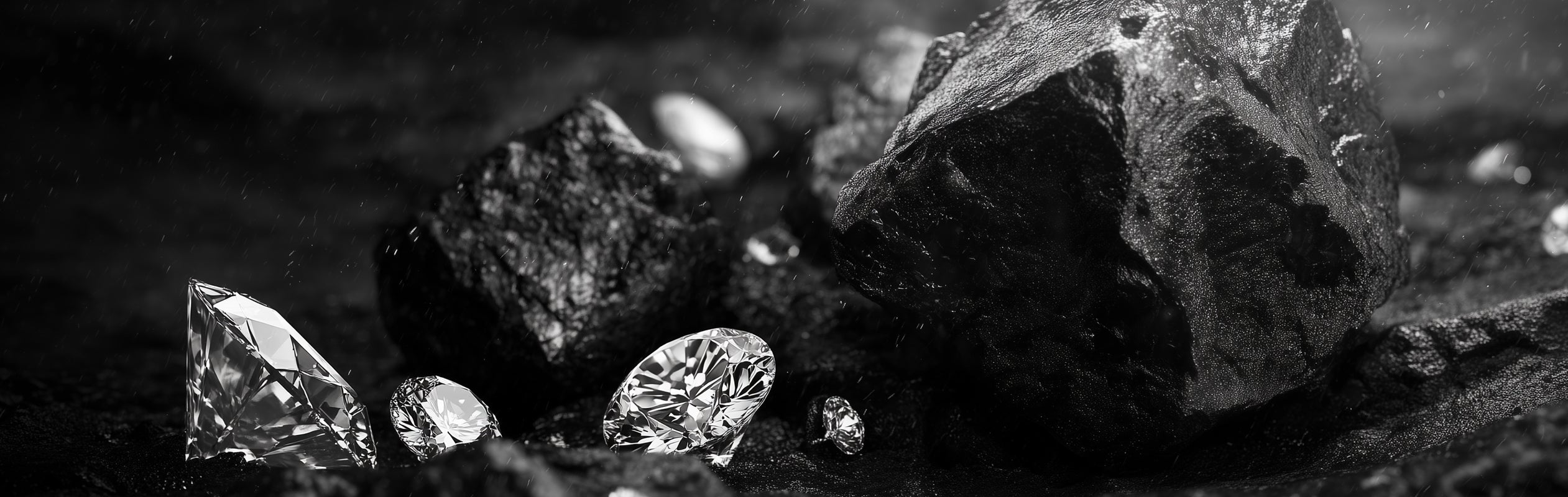
Natural black diamonds get their color from Mother Nature. During their formation in the earth, other minerals are trapped inside the diamond. The extremely high amount of these other minerals, called inclusions (small spots) - such as graphite, pyrite, or hematite - are what give diamonds their black color. These inclusions are what give them a unique character; no two diamonds have the same inclusions.
Carbonados (from Spanish carbón – coal) are also natural deposits found only in Brazil and Central Africa.
How and where natural diamonds form is still a mystery. The latest scientific theories place the formation of black diamonds in space - they would have arrived on Earth brought by meteorites during the formation of the latter, over 2 billion years ago. Other geophysicists, however, argue that they are of terrestrial origin.
Treated black diamonds are found in nature, but their black color is not natural. They become black through heat treatments that enhance their color.
Synthetic black diamonds are identical to natural diamonds but are made in a lab, so neither the stone nor the color is found in nature.
Natural black diamonds and Carbonados can vary in color from light gray to pure black, depending on the number of inclusions. Treated and synthetic black diamonds usually have a more uniform black appearance.
As with all gemstones, natural black diamonds are significantly more valuable and desirable compared to treated or lab-created ones.
Properties of Black Diamonds
Among all gemstones, black diamonds are recognized for their durability, scoring a 10 (the highest possible) on the Mohs scale of mineral hardness, being even harder than most colorless diamonds.
Natural black diamonds are usually completely opaque, with a high luster that gives the stones an almost metallic appearance. They can contain hundreds, if not thousands, of microscopic inclusions. Although they are valued for their superior hardness, these inclusions make black diamonds more vulnerable to breaking than colorless ones, and cutting and polishing them can be difficult.
Unlike white diamonds, black ones can cost less because consumer demand is lower. However, tastes are changing. In recent years, black diamonds have become increasingly popular and appealing, especially for those looking for something exclusive and different in an engagement ring or other types of jewelry.
Like colorless ones, black diamonds symbolize eternal love, making them perfect for an engagement ring. They are also associated with passion, action, and energy.
Famous Black Diamonds
The oldest known black diamond is Black Orlov, weighing 67.5 carats and dating back to 1750.
Spirit of Grisogono weighs 312.24 carats and was found in the 1990s in Central West Africa.
Enigma is the largest polished black diamond ever auctioned, weighing exactly 555.55 carats and featuring 55 facets. It will be auctioned in February 2022 and is expected to sell for more than approximately 7 million USD. Some experts support a terrestrial origin, while others in the diamond field say that the massive black jewel came from outer space.
Due to their dark color, black diamonds have an extremely distinct, unique appearance that sets them apart from other gemstones. They look stunning when paired with metals like 14k white gold and platinum, as these help highlight their black color. They are also often placed next to colorless diamonds as a way to create visual contrast. These combinations can look fantastic for both engagement rings and other jewelry.